Browse our most frequently asked questions by topic.
We are a supply-only company. We do not fit
or template worktops ourselves. However, we have a network of recommended
fitters and carpenters across the UK.
If you share your postcode, we can check who we have in your area and pass
their details on to you.
For compact laminate, here is the joining
process:
First, you use a butt joint with connector bolts. You butt the worktops
together, route a pocket for the bolts on the underside, and then use the bolts
to squeeze the worktops together.
Second, to get them perfectly flush and level, you use biscuit joints or cookie
dowels. These create a mechanical connection that aligns the two pieces
precisely on the surface.
For sealing, always use colour-matched silicone, not standard colourfill. The
colour-matched silicone makes the seam virtually invisible, keeps it
waterproof, and matches your worktop pattern.
For wooden worktops, the process is very similar: butt joint, wooden biscuits
or cookie dowels for alignment, and an appropriate wood glue or silicone for
sealing.
For chipboard laminate, a Mason’s Mitre (or Hockey Stick) joint is used instead
of a butt joint. This requires a jig and a router, and sealing with ColorFill
is essential to prevent water getting into the core.
We can supply colour-matched silicone alongside your order to make sure you
have the right match.
Compact laminate is installed the same way
as stone or quartz. You silicone or glue it directly onto the top rails of your
cabinet carcasses.
Run a bead of high-quality kitchen silicone along the top rail of every cabinet
the worktop will sit on, lower the worktop into position, press it down firmly,
and let it cure. Once the silicone sets, the bond is permanent and very strong.
No screws, no brackets, no clips needed.
One tip: use a non-setting or slow-set silicone on your first pass so you have
time to adjust the position before it cures.
Direct screws through compact laminate are
not recommended. The material does not hold a standard screw well because of
its density.
The correct method for fixing to cabinets is silicone or adhesive. A bead of
high-quality kitchen silicone on the top rail of each cabinet creates a
permanent and very secure bond.
If your carpenter specifically needs a mechanical fixing, for example for
attaching an undermount sink, there is a solution: brass threaded inserts.
These are pressed into the compact laminate and then a threaded bolt goes into
the insert. This creates a proper mechanical connection identical in strength
to a screw into solid material.
Compact laminate is much harder and denser
than it looks, so the right tools matter.
For straight cuts: a plunge saw with a guide rail, using a sharp TCT (Tungsten
Carbide Tipped) triple chip blade or a PCD (Polycrystalline Diamond) blade.
For sink cutouts: a router with a TCT straight cutter.
For finishing edges: 240-grit sandpaper to sand the edges, then bevel the edges
with a 22.5 or 45 degree chamfer using a router, and finally a drop of linseed
or mineral oil to make the core colour pop.
The number one cutting mistake is trying to cut in a single pass. The material
is dense so it generates heat which blunts blades and chips the surface. The
correct method is to cut in increments of 2 to 3mm at a time, working down
through the 12mm thickness in multiple passes. Sharp blades plus incremental
cuts equals a perfect result.
We have a full step-by-step cutting video on YouTube if your carpenter wants to
watch it before starting.
For bespoke orders with sink cutouts, we
never cut until you have approved the CAD drawing. You place your order first,
then we contact you to confirm all the cutout dimensions before anything is
made.
The only thing we need from you is your sink manufacturer’s cutout sizes, which
should come with the sink or be available on the manufacturer’s website.
For compact laminate, our minimum edge distance is 100mm from the front edge of
the worktop to the start of the cutout. This protects the structural integrity
of the overhang.
We have a full guide on measuring sink and hob cutout positions here:
houseofworktops.co.uk/blog/how-to-measure-the-location-of-a-sink-or-hob-cutout-on-a-kitchen-worktop/
Yes. Belfast sinks are typically fitted as
overmount sinks, meaning the sink sits on top of the worktop and the rim rests
on the surface, sealed with silicone. This works perfectly with compact
laminate.
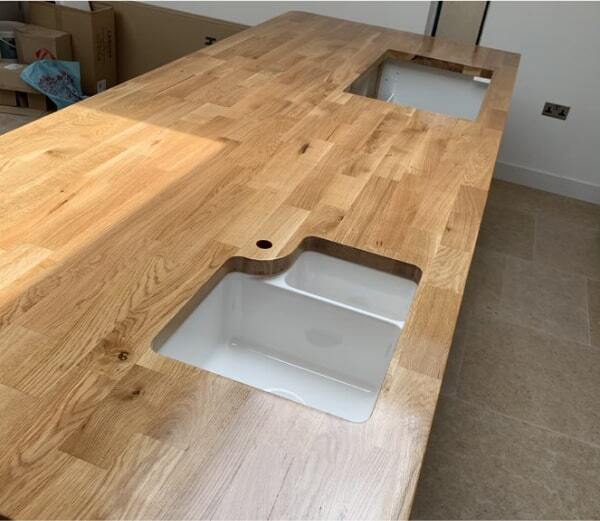
If you want a cleaner, more modern look with the sink recessed below the
worktop surface (undermount style with a Belfast), that is also possible with
compact laminate because of the solid waterproof core.
When you order, tell us your sink model and dimensions and we will make sure
the cutout is correct for it.
Every worktop needs measuring on site to
make sure it fits your kitchen correctly. We do not offer templating or
measuring ourselves, but you can measure at home or hire a local fitter to do
it.
If you do not have anyone to help and you do not want to do it yourself, share
your postcode with us and we will check if we have any trusted fitters in your
area.
We cut your worktops based on the
measurements you provide. We do not offer templating or measuring on-site
ourselves.
For bespoke orders with cutouts, we make it safer: once you place your order,
we create a detailed CAD drawing based on your dimensions and send it to you
for approval before we make a single cut. That approval step protects you.
If you are not confident measuring yourself, we can recommend trusted fitters
in your area who can measure and install. Just share your postcode with us.
Chat with our support team in real-time for instant assistance. Available Monday to Sunday,
08:30 - 17:00.
Speak directly with our customer service team during business hours. Available Monday to Saturday, 08:00 - 18:00.
01727 260688